
Interview with Esme Symes-Smith
author of best-selling middle grade series, Sir Callie

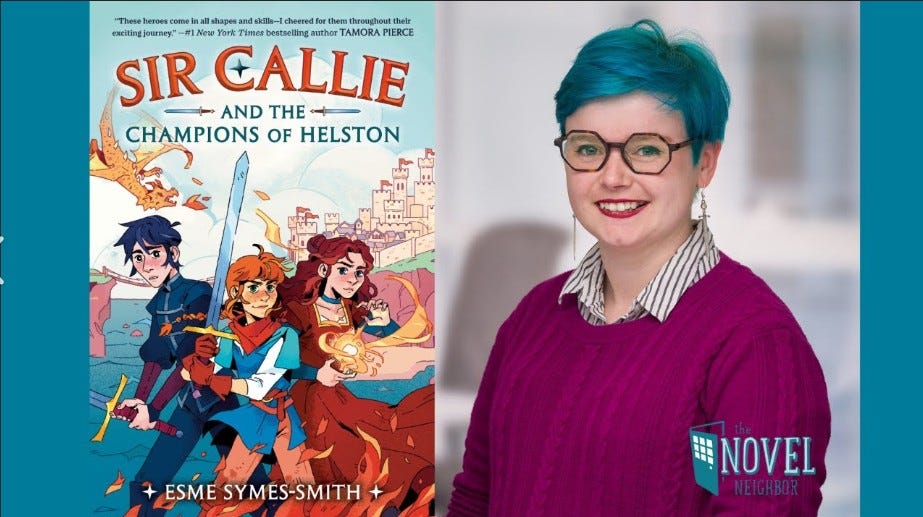
I had a super thought-provoking talk with Esme Symes-Smith this week, author of best-selling Middle Grade Sir Callie series. Check out some of their pearls of wisdom by listening to the audio or reading the transcript below. Then, be sure to check out their website at: https://esymessmith.com
0:00: Introduction
2:02: Where the idea of Sir Callie started
8:40: How writing books two (and beyond) in a series differ from book one
11:17: Book four release and cover
12:14: What they’re writing next
14:57: Writing routine
16:17: What draws them to writing Middle Grade
20:42: Challenging subject matter in books two and three
23:00: Elowen’s rage
25:06: how they navigate writing such tough emotional subjects for children
28:55: advice for aspiring authors
30:20: scene in which characters talk about their identity or “words”
33:59: next series’ working title
36:23: Laura’s favorite character
38:45: experience writing as a child to disassociate from big feelings
Laura:
Thank you so much for being here. Welcome to Esme Symes-Smith (did I say your name right?)
Esme:
You did! Congratulations because that’s a rare thing.
Laura:
I cheated. I listened to one of your audiobooks and heard you say it.
Esme:
Listen. My expectations are below ground level. It’s amazing what you can get with four letters.
Laura:
So, Middle Grade Fantasy author. Author of the Fantasy series, Sir Callie, which I just finished reading, so I’m super excited to be here (the first three books, at least) for a chance at a conversation. I was hoping you could start by telling us whatever you want to about yourself.
Esme:
My name is Esme Symes-Smith. I’m originally from England in Devon which is in the southwest. I moved to Missouri in 2012 when I graduated university, because I met my wife on tumblr through Sherlock Fanfiction. I invited her to tea, and she came, and we decided to get married, all of which happened within six months. Then I moved to the States and have been here ever since.
I’ve been writing since I was twelve. I started in Fanfiction which is what made me love telling stories, especially for an audience who’s excited about it. Sir Callie is my first published series. It was a really long trip to get there, but once we found the imprint at Labyrinth Road at Penguin Random House and my editor, Lisa Abrams, it was smooth-ish sailing from there. I’m very thankful.
Laura:
What I loved about Sir Callie as a reader and what I admire so much as an aspiring Middle Grade author was…I feel like you have it all. You have this nuanced cast of characters, a super interesting magical world, a fast-paced plot, and more emotional depth that I'm used to in the Middle Grade genre. So, I'm curious where this story started for you. Did you begin with voice or an outline? Did the world emerge around your characters?
Esme:
I'm very much a character writer. I can actually pinpoint the exact moment. It was March 31st of 2020, right when we hit the pandemic.
The book that I got my agent with was on submission (and if you're an aspiring author, you'll know the horrible hell that is). Submission querying is awful. Submission is horrible. We’d just sent that one out and it was the pandemic. I wasn't working. So, I was just going, “Oh, God, what am I gonna do? Oh, no. I don't have a book to edit anymore because it's done. And now I have to think of something else and I don't know anything.”
And then I saw a tweet.
And, so, I love the Tamora Pierce books. They're my absolute favorites, especially the cowboys like Jessica. It's so good.
And someone had written, “I really want a like thruple romance book about Alana, Thayet, and Jonathan.” And I was like, “Oh! That's sparking something.” And I suddenly had these three characters and they were kids.
It wasn't a romance, but it was a fierce, queer, gender-fluid knight, a fierce girl and a soft prince. And, immediately, it was Callie, Elowyn and Willow. And I was like, “Oh, now I have to find a story for you.” So, it's been really interesting looking back and seeing the beginnings of it because I did write out a little outline to get myself going because I wanted to do it for April NaNoWriMo.
I wrote out a little thing and I had absolutely nothing except these three characters. So, it's really funny looking back and seeing all the things I've changed. And I remember thinking that maybe Callie had three older sisters and everyone got massacred and Nick has a drinking problem because of it. And I'm happy with the choice that I made to step away from that and to develop it in a different way. But I definitely don't necessarily plan. I like to give myself a lot of space to write organically and be fluid about it, which can be good or a bad thing, depending on the day.
Originally, Callie was supposed to be a one book. It wasn't supposed to be a series. So, I wrote it, wrote it, wrote it. Then we had to chop it down from, like, 75k to 60k, because that's the sweet spot for middle grade. And I had all of this extra background stuff I'd cut out.
And then we went on submission in February of 2021, because, obviously the Pandemic meant I could really focus on this book and rewrite it a thousand times and edit it a thousand times. It was great.
Then, 10 days later, someone from Penguin Random House wanted to talk to me about it. I was just like, “Huh?” And I remember the exact moment because I was sitting downstairs where our TV is in the basement, watching Schitt's Creek, just feeling awful about everything. And my agent sent me the gif of Big Bird bashing a door down going, “Esme! Get on the phone right now!”
And it's like, “Oh, God. It's either going to be something really great or something really horrible.” Yeah, it was wild. Publishing goes from 0 to 100 real fast. Anyway, I talked to Lisa Abrams, who was just the nicest, sweetest, smartest person I'd ever met. And she got my book in a way that even I didn't.
And then she was like, “You know, the one thing I wanted to ask was. I'm thinking this could be a big, sprawling adventure series. How do you feel about that?”
And I'm just like, “Oh, my God, Yes! I have all the stuff. I can put all the stuff in.” Because there are no dragons originally at all. Alys was only in the background. The book was originally just about the Helston plot. There was nothing about Dumoor. But I wanted to write about the Queen and her girlfriend who went rogue and all of that stuff.
But I had no idea what I was doing. And the Dragon’s Roost was the hardest book I've ever written because it was my first one on a contract. And it was so bizarre because everyone was really loving book one, which made me more anxious that everyone is gonna hate book two.
But then I relaxed and could just enjoy the process and my editor encouraged that I can tell the story I want to tell, even if I don't know what it's going to be yet. Does that make sense? I've been very lucky that my publishing team trusts me enough, and I'm glad they do, because just wing it as I go and hope that everything works out.
And it's been really fun because there's a certain part at the end of book two (which I won’t spoil for people who haven't read it), but it was completely unexpected, and I didn't know it was going to happen until it happened.
And I remember writing it and going, “I don't think I'm allowed to do that.” So, I called my wife, asking, “Is this character allowed to be this thing?” And she was just like, “Yeah, totally.”
And ever since then, people have been applauding me for how well I worked it through and the foreshadowing. And I'm just like, “Sure.”
Laura:
That's amazing. I love that you just trust your instincts with that and it works out.
Esme:
It does. I don't know. I'm waiting for it to stop working.
Laura:
Yeah. Well, my next question was actually what you just touched on, which was: How is writing Book Two and beyond different than writing the original? Were there any unique challenges to it? It sounds like maybe there's a lot more pressure.
Esme:
It's just very, very strange. And I will say I'm thankful because when I first came to America, I had another little crisis of, “Oh, my God. I went to school for creative writing, and I don't know what to do with it.” And my wife told me about NaNoWriMo, which is national Novel Writing Month. And I was like, “Okay, I'm gonna do it, and if I don't do it, I'm never gonna write again.”
And I've never been able to do anything else. So that was a big deal for me. I was like, I don't have any ideas. I don't know what I'm gonna do, but I'm gonna write 200 pages in 30 days, and we'll see how it goes. So, I've been doing that every year subsequently, and I’m very practiced at drafting fast. I can do a draft in a month, no problem. But it's the making it good in a short space of time that is very scary.
I can get the plot down. I can get the character stuff down, but getting the prose to a level that I'm happy with it, that is the most stressful part because I need to be able to sit with it, and it's really hard to get the time to do that. For book two, I definitely made the cardinal mistake of doing a lot of editing when I got my copy edits back, which you're not really allowed to do.
But if I don't do it, I'm gonna be unhappy with the book, and I can't have that. So, it was really hard. Oh, my goodness. It was really hard. And it's honestly still hard. But every book is different. And I'm working on the first book of the new series right now, which is a whole ‘nother terrifying thing. I don't know how you feel about this, but once you're done editing and you have this beautiful thing, and then you have to look at a blank page and all the mess of it, it's horrible.
But looking at this beautiful series that everyone loves, and it's so shiny and pretty, and then I have this blob of Plasticine. I'm just like, “Oh, God.” So, it's a lot of blind faith for me.
And I'm thankful for the encouragement from my editor because she definitely has more faith in me than I do in myself.
Laura:
Oh, that's lovely.
Well, that was one of my later questions. Does that mean book four is already done?
Esme:
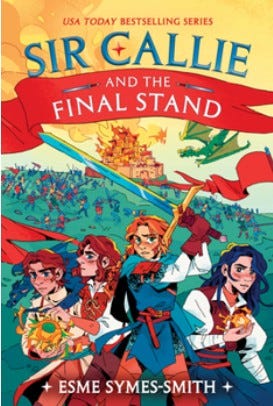
Oh, my gosh, yeah. Book four comes out October 14th.
Have you seen the cover? It's so good. It's so beautiful. I'm so, so lucky. The artist that they had to do the covers has just been the most amazing person to work with. I've been so lucky with my whole team, honestly.
Laura:
Oh, it's great. Callie and the Final stand.
Esme:
I know. Having all the kids together was the most fantastic thing.
Laura:
Yeah. And they have a dragon in the background.
Esme:
There was an extra dragon at one point. And I'm just like, “I don't know who that is. That's not a dragon that I'm familiar with.” We have the dragons that we know. And then we had an extra one. I was like, “No, no.”
Laura:
Yeah. No, no. Oh, man. So cool. I'm excited. Okay, so October. And you're already writing something new? I mean, that was another question: what's on the table?
Esme:
Publishing is such a weird time-travel type thing.
It's truly bizarre because, you know, as the Sir Callie books come out, I'm two books ahead at all times. So, releasing book two was hard because people had barely read book one, but I was pretty much done with book three, and I was starting book four.
So, knowing what I can talk about and not spoiling anything and getting confused…like, ugh, what a mess. But yes, I'm working on the first book of a new series which comes out fall 2026.
(Nervous laughter) Yeah, that's next year! That's fine.
I've been doing a book a year for a really long time now, because you write the book, and then there's a year in between finishing the book and it coming out, but in that year, you're writing the book for the year after, so on and so forth. Don't get me wrong, I'm so lucky. I'm so thankful that I get to write more books, but it's very intense.
Laura:
That sounds pretty intense.
Esme:
And as soon as you're done with one draft, you're immediately into the next one. Like, immediately.
There's no time to stop. So, my brain is quite tired. And especially world building for the new series on a deadline, that was a new thing altogether because for Sir Callie, I had the luxury of time. It wasn't sold when I wrote book one, and then we sold it in 2020, and it didn't come out until 2022.
So, I was like, I have time. And then I can physically feel my brain working when I'm working on the new one, the world building and the intricacies. And I hadn't realized how comfortable I'd gotten in Callie's world.
I could just let the characters run. Even the plot's great because it's basically all inevitable at this point, right? Because it was just all set up, and now here we go. So, yeah, my brain is really tired.
Laura:
And it's no walk in the park, working with little children all day.
Esme:
That's my break, honestly.
It's so funny because I started early childcare the week I got my book deal in 2021, which is wild. But I love it. My routine is I get up in the morning, I go to some kind of coffee shop, get out the house to do my book work, and then I go to my day job, 12 to 6, and I come home and I just relax. And that's taken a while to work out.
But honestly, getting away from my computer, just literally touching grass and little babies and doing some diapers, like, it's so good. It's fantastic because I'm not in my head about it. I'm not feeling guilty for not doing more. And then I can just feel like I'm doing something useful because it's really hard to feel like you're doing something useful when you're writing stories. That's how I feel anyway. So. Yeah, no, I love it.
Even if I made a gazillion dollars, I think I would still want a day job just because it keeps my brain a little bit more calm.
Laura:
Yeah.
Esme:
Yeah. But that's never gonna happen. Doesn't pay. It's fine.
Laura:
I've never heard anyone describe loving changing diapers, or that it’s their desired break.
Esme:
Sometimes it's better than staring at your computer screen. Yeah, it's good. I love it. And they're really cute, even if they're obnoxious for a time.
Laura:
So, given that you are around these little kids and, you know, a lot of your subject matter is definitely serious and heavy enough that it could be different age groups, what draws you to writing for Middle Grade?
Esme:
So, originally, I was very in denial that I was a Middle Grade writer. My first book, I didn't know what genre it was, and I didn't know what age category it was going to be. And I didn't know that I had to know these things.
So, the first time I ever spoke to an agent, it was very informal. And she was like, “Yeah, Esme, this is really good, but what is it?” I'm just like, “What are you talking about? You've got it in front of you.”
Because, you know, I grew up on books like Philip Pullman, His Dark Materials, like, what is that? Who knows?
But I'm not Philip Pullman, so I can't do that. And I had, like seven points of view. Some of them were little kids, some of them were older adults, and it was just a story. So, when it came to trying to get published, I had to work out what it was. I tried to make it an adult book about kids, like Secret Life of Bees, for example.
And then I tried to do it YA. And then I went to a course at the Writing Barn in Austin, Texas. So good, Amazing. And one of the authors there, they weren't the person running it, but someone doing the course with me. They sat down with me to work on my query, and they were like, “It’s Middle Grade,” and I was like, “How dare you? I am a serious author. I don't write for children.”
And then I was just like, “Esme, just sit down. All the books that you loved as a kid, they were Middle Grade books,” and I realized that you can do as much with Middle Grade as you can in YA and Adult.
But the difference with Middle Grade is that there's hope at the end. I love that. And especially writing Sir Callie, I always needed to know that it's going to be okay. And I've always promised my readers the kids are going to be fine.
And I love it because you can be silly with it, you can have fun with it, but you can also hit the hard points. And, as a kid, I always loved serious stories because I was a very serious kid. But I never saw myself on the page in adventure stories.
Like, not as a queer person, but as an angry kid. As a not-shiny-hero type kid. Like, I always saw myself in the antagonists and the villains and all that stuff. The people who’ve been hurt but can't necessarily forgive as easily as some people can.
And it always felt like, me being me, I knew who I was, but I would never be the hero of my story. So, I've always written about very messy people, very damaged people. I like to get into that and say, you know, everyone has their own path through trauma.
And I think that's the most important thing to say, especially to preteens and young teenagers. You know, “You are so out of control right now. Like, you have no control because your world is the adults around you, and who knows what they're doing? They don't even know what they're doing.”
So, I was very lucky that I could write this fun Fantasy series but also hit some points that were really important to me personally. And especially with the twins, Elowen and Edwin, seeing the different ways that they come through the same situation was delightful for me because, I think that's an important thing, too.
No one comes through even the same situation in the same way. That's why I love it, because I can have fun with it. It can be silly, but it can also be very serious because at that point in your life, at 12 years old, that's when you start to understand the world around you.
But there’s frustration that you can't do anything that comes along with that.
Laura:
Yeah, I definitely got that sense. That's a running thread through, I would say, all the books. I felt like it especially got tougher in books two and three, maybe also because we share points of view with Edwin then.
Esme:
Yeah, that was hard. And I didn't expect to be allowed to be able to do multi POVs. I started drafting in multi POV just because it's easier for me to know who's doing what and who's feeling what. And then I was chatting to my editor. I was like, “Yeah, it's going pretty well, but right now it has four points of view.”
And she was like, “Okay.”
I'm just like, “What? Excuse me?”
But it was.
It's awesome. Like, I will always sing her praises because she's never told me something is too much. She's always like, “Yes,” and “Let's think of how to do this that's good for middle grade readers and makes it accessible.”
It's not about dumbing it down or lessening the way it hits but making it accessible to people. And I'm really thankful for that because that had never occurred to me before.
It was definitely hard because I didn't want it to be gratuitous. It's not even about what happens, but what it does to your brain, if that makes sense. And how can you keep moving towards your happy ending when you're fried, basically. And I think as a collaboration, we did a really good job on that. I hope so anyway.
I'm very thankful for it. And I love Elowen, too, because she has such a different experience with her parents but also similar in a way. But her rage is so potent and single-minded, whereas Edwin is very much like, “I have to be able to forgive the people that have done this to me.” Elowen’s just like, “Absolutely not. Let's burn everything down.”
So, that tension between those two has been really interesting to write about, especially towards the end of the series. I'm so excited for people to read.
Laura:
I love that you just mentioned seeing yourself in protagonists when we were kids and how you rarely will get an unkind, unforgiving, flawed character in a Middle Grade novel. I loved Elowen's rage. I was just like, “Yeah, that's totally real.” And you see her struggling with Callie with it, but she was following her path and she had to do her thing for a while there.
Esme:
Yeah. Book three was such an interesting one to write for Elowen in particular because she will never admit that she's wrong, and the whole of book three is her going, “Oh shit, oh God. Oh no, I made a terrible mistake.” But she's like, “Nope, I did this. I'm owning it. It's gonna be fine.”
And it's not fine at all. And I really wanted to write a friendship breakup in this series because that's such a hard thing to deal with, and I was going through one, too, at that point. So, having Callie and Elowen fight through book two and then not see each other at all in book three, and then they can talk about it in book four. Neither of them stop being who they are but they still manage to find the middle ground where they can still love each other, which I think is really cool. Honestly, that's what I love most about my characters.
And I feel like I'm talking as though I'm not the one writing it, but it's such a real thing in my brain. I love that they can all come through without having to sacrifice who they are, but still willing to change, not just for the sake of another person, but for their own peace, you know?
Laura:
Yeah.
I was going to ask how you navigate such tough emotional subjects for a Middle Grade audience, but you have already talked a bit about that. Is there anything else you wanted to add about how you've navigated that?
Esme:
I think just always bearing in mind that we're not doing it for fun. We’re doing it because it's important. And that sounds really smug, but it's not. It was always important to me to give kids the books that I needed. I needed Callie, I needed all of them.
And to have four heroes who see the world so differently, who are all heroes but in completely different ways. Like, I love Willow so much because he stays kind, and sometimes that's a fault of his, and I love that for him. And you know, Callie is very stubborn and single-minded, which clashes against Elowen, but they still love each other.
And Edwin can go two steps forward and one step back the whole way through. But that's his journey, and that's right for him. I love that they all get to do that themselves.
I've really enjoyed writing the adults, as well. They've been just as interesting as the kids, which was a really unexpected thing for me. And I think it goes back to what I said earlier:
When you're a kid, your whole world is the grown-ups around you, and that can be good or it can be not so great. But getting to explore that explicitly in Middle Grade was really rewarding for me. A little bit about myself is I was raised by a single mom and then I left home when I was 12 and moved in with my grandparents. And having those two different home lives and seeing the home lives of my friends around me that were so different, and wondering why my experience is so different from everyone else's…
It's a thing I didn't necessarily get to see in the books that I was reading, that I think would have appreciated a lot. But getting to see Callie make the choice to leave their mom's home with Nick, Nick supporting them, that was a really big thing. And actually, one of my very first events I did was at a library, and a mom came up to me. She said, “I really love that you don't give Callie's mom any space or any kind of redemption.”
And I kind of debated whether to bring the mom back and give them a reconciliation. But actually, she's not even part of the story. She stepped back. This has got nothing to do with her. And I really, really appreciated that.
I wanted to say that one of my biggest delights is making Perin absolutely the worst, with no redeeming qualities at all. That is just delicious to me because I have always loved very interesting villains, ones that you can redeem in fanfiction or whatever. And he's just an asshole. He's a massive prick just because that's who he is. And I think that's a really important thing to say to kids, too, that some people just suck. They just suck.
There's nothing deeper than that. Some people just like to hurt other people. And I'm lucky that I've been able to do that.
Laura:
Do you have any advice for aspiring authors?
Esme:
Sit on your butt and put the words on the page. That is the best advice that anyone ever gave me.
And it's the best, best advice that I continue to tell people. I never know what I'm writing until after I've written it. So, to get to the end is the most powerful thing that you can do as a writer. Finish the damn thing. It doesn't need to be good. It doesn't need to be finished. It just needs to say “The End” at the bottom, and then you can start making it a story.
It's hard. It's so hard. And I had to tell myself the same thing every single freaking day. Because writing is both the thing that I want to do more than anything else and the thing that I want to do the least. And most days it'll be a huge fight to get myself to come and sit at my computer and put the words on the page, but whilst I'm doing it, and afterwards, I feel so good. And I'm just like, “Dang! Why can't I remember this feeling?”
It always feels so insurmountable and impossible. But those feelings are because you care about your words and your work, and that's a good thing. It's a good thing to feel that way.
Laura:
Oh, speaking of your words. This isn't so much a question. I just love that moment in book two when the reader gets to listen in on the conversations about identity and words and labels.
I think it's so awesome that your readers get to have access to this conversation, because not all of them will. When I was teaching middle and high school, I led the GSA, and I was kind of floored by how wise kids are these days.
Esme:
They're so wise. They're so smart. I work with a group in St. Louis called LIT Shop, and it's all for girls and genderqueer kids. And they're so smart and so clued into the world and what they want from it. And I'm just like, “When I was your age, all I cared about was Pokemon.” Like, for real. It's wild.
Laura:
Yeah. No, they're so clued in, like you said. And their vocabulary was amazing.
And just, I was blown away by how well they knew themselves and the world, but I also know that they were the minority in the school. Not everybody was having those conversations.
So, I love that it's in this book. This is the best scene.
Esme:
It's so interesting because when I was writing it, I knew I wanted to put those words on the page explicitly because, there's been so much conversation about how you never see the word “lesbian” on the page, for example. It's important just to have those words for the community.
But this is a Fantasy book, and it felt really weird writing it. It just felt bizarre the whole way through, and I felt like it was gonna get cut. Not for content. Just because it feels like such a weird conversation to shove into a fantasy book.
But so many people have told me that they love that scene, and I love that they love it. That makes me so happy because it was so unexpected. But I love that the kids can sit down with queer adults who are living their best life, who are happy and stable. As a queer Author, I love being able to give that to young queer people, too. To say, “Hey, no matter how bleak it looks on the news, I'm doing great. You can do great, too. It doesn't matter what your words are. It doesn't matter who you are, who you love, what you identify as. Like, you are a great human being and just be you.”
And it sounds so cheesy to say it, but, like, it's so important just to remember we can live a happy life and we deserve to live a happy life.
And we are, despite what they're saying. Don't even get me started.
Laura:
Yeah, and it's a really nice moment for the characters too, because there's a lot of crap going on, but they have this moment of belonging and discovery. It was so lovely.
Well, thank you so much for meeting with me and having this conversation and thank you for putting these wonderful books into the world. Callie is also the kind of friend that I would have loved as a kid, and I'm sure they're a very good friend to the current kiddos.
Esme:
Yes. They do some good work. And I'm really excited for you to read book four.
Laura:
Me too. And can we hear what the next series is gonna be called?
Esme:
The next book… Right now it's called Shadowbound. I don't know if that title is gonna stick. We'll see. And I have an entire draft and another half draft, and I still don't know what it's about.
Probably three quarters is in a magical world and a quarter is in our world. There are portals between, and it's all about the monetization of magic and the way it's distributed, the way it's used, the way it's been changed. That’s really exciting to me right now. It's three points of view in book one. I think it's going to be three books or moved to four books. It was inspired by my friend's cat who is in the book.
Laura:
Amazing.
Esme:
Yeah. No, I'm really excited.
I say that if Sir Callie is Tamora Pierce-esque, this one is Philip Pullman-esque. I would never put myself at that same level, but it's that kind of magical world. It feels modern, and it's very political, very economical. It's about economics, basically. I think I’d been reading a lot of books about the Great Depression and the Dust bowl, like, for no reason at all.
It wasn't to do with the book at all. But I was listening to them and I was like, “Oh. Corn, magic. Same.”
I don't know. I don't know. But I'm excited about it and I hope that people like it, and if they don't, I do.
Laura:
I'm totally intrigued and I will absolutely read that.
Esme:
I do hope to revisit the Sir Callie world one day. I've got a lot of ideas that I want to continue on.
Laura:
Nice. Oh, it'd be fun to see them all grown up, maybe.
Esme:
Yes, it would. I have so many thoughts on who they are as grown ups. Who's your favorite character? I have to ask because I ask everyone.
Laura:
Oh, gosh.
Esme:
You can pick one kid and one grown up.
Laura:
Oh. I immediately went to the kids. Okay, I would have had a crush on Callie, but I think my fave was Willow.
Esme:
Yes.
Laura:
I would have been better friends with Willow, even if I admired Callie.
Esme:
He’s much easier to be friends with. I love that. Thank you for telling me.
Laura:
Yeah. And for the adults, I mean, Nick maybe? Neil is pretty awesome too.
Esme:
Yeah, Neil's the go to. People are very polarized about Nick. It's really interesting.
I sat in on a book club that was doing Sir Callie, and everyone was like, “Yeah, Nick! He's so awesome.” And there was this girl with this stormy look on her face. I'm sitting next to her and I was like, “What do you think?”
And she was like, “I hate him!!!!”
Oh, that's so cool. I love that people can read a book and take it 10 different ways.
Laura:
Yeah. Okay, now that you say that, it's true. There are moments when you're very upset with him. And there are moments when you're just like, “Callie, he doesn't deserve that much admiration.”
Esme:
He tries really hard, but it doesn't always work. And he comes from a very privileged place and he doesn't always understand.
Laura:
Yeah. I mean, Neil is like Willow. You just want to, like, smooch him or cuddle. Cuddle with those warm dragon scales.
Yeah.
None of the other adults are very interesting.
(Laughter)
Esme:
Well, thank you for telling me. I appreciate it.
Laura:
Yeah. All right, well, thank you so much.
(Brief interlude about Laura’s novel and the definition of dystopian novels).
Esme:
I mean, I write to disassociate, so kudos to anyone else who's escaping into stories and making sense of things in that way, because I couldn't do it otherwise.
Laura:
But you deal with plenty of really hard stuff in your stories. I don't think you're escaping.
Esme:
So, it's not escaping, as in, ignoring it. What I used to do as a kid is when I had big feelings that my body couldn't handle. When it was too uncomfortable. I would give it to a fictional character, and I would write.
And you can kind of see it from a third-person perspective, which made it so much easier to work it out and get into the psychology: why does this person feel this way? How did it come to be this way? Blah, blah, blah. So, I mean it in that sense more than just, like, blind.
But for sure, having book four come out this year is so weird because: one, it's the book I wish I could write right now because it'd be very cathartic. And two, I feel like Trump read my book. He's just like, “Yeah, I'm king,” and I'm just like, “Everyone's gonna think that it's just so on the nose.”
But I did it first, right?
Laura:
Oh, my God. Yeah.
Esme:
Hopefully, it’ll end up the same way. And that’d be good for everyone.
Laura:
Right? October, maybe. That's when everything will turn around. Everyone will read your book and know how to solve it.
Esme:
It's gonna be fine. We survived before, we'll survive again. And books help.
Books help. Write them, reading them, sharing them. Everything helps.
Laura:
Yes.
Esme:
All that you do with your blog and your words.
Laura:
Well, thank you again. This was delightful on a Wednesday evening.
Esme:
Thank you for reaching out. Thank you so much. I really appreciate it. Good luck with your words.
Laura:
Thank you. Good luck with your words, too. Okay, bye.