
Necessary Narratives
a review of Salmon Rushdie's memoir, Knife

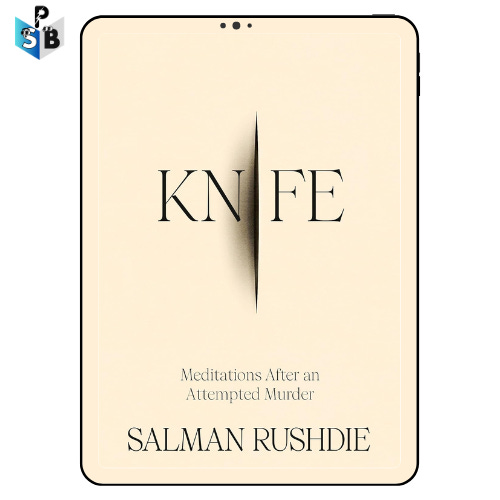
Sometimes, a book crashes through me, like a wave carrying a shell ashore. Other times, like a diver in deep water, I swim its prose for hours, hoping to bring drops of its truth back to life on land.
Using this metaphor, my reading of Salmon Rushdie’s memoir, Knife, was a full scuba experience.
Perhaps it’s the context of our political reality, here in the U.S., with freedom of speech so threatened. Or perhaps it’s his poetic way with words, or his honesty and brilliance. I usually prefer what our imaginations can show us through fiction to the mundanity of real life, but Rushdie uses his miraculous recovery from attempted murder to pen more than a one-dimensional tale: he speaks on literature and the war of unwritten narratives, of religion and love, on second chance lives and politics, and…wait, did I say “scuba experience?” No. Reading Knife was more like a mermaid transformation.
I stayed submerged for days.
For the purpose of this post, though, I’ll focus. The book’s wisdom, indeed, stretches as far as the horizon. My friend and fellow writer, Catherine, shares an insightful recommendation in her substack review, too, so check it out! But for these few paragraphs, I’ll explore just one of its many currents, “the power of words.” Partway through the book, Rushdie shares the speech he delivered at PEN America’s 2022 Emergency Writers Congress, which I now share with you in (almost) full.
Behold it’s brilliance:
“We are engaged in a war of narratives, incompatible versions of reality, and need to learn how to fight it. A tyrant has arisen in Russia and brutality engulfs Ukraine, whose people, led by a satirist turned hero, offer heroic resistance and are already creating a legend of freedom. Meanwhile America is sliding back toward the Middle Ages, as white supremacy exerts itself not only over black bodies, but women’s bodies too. False narratives rooted in antiquated religiosity and bigoted ideas from centuries ago are used to justify this, and find willing audiences. In India, religious sectarianism and political authoritarianism go hand in hand. Violence grows as democracy dies. False narratives of Indian history are at play that privilege the majority and oppress minorities, and are popular, just as the Russian tyrant’s lies are believed.
‘This is the ugly dailiness of the world. How should we respond? It has been said that the powerful may own the present but writers own the future, for it is through our work—or the best of it the work that endures—that the present misdeeds of the powerful will be judged. How can we think of the future when the present screams for our attention, and if we turn away from posterity and pay attention to this dreadful moment, what can we usefully or effectively do? A poem will not stop a bullet. A novel cannot defuse a bomb. Not all satirists are heroes.
‘But we are not helpless. Even after Orpheus was torn to pieces, his severed head, floating down the river Hebrus, went on singing, reminding us that song is stronger than death.
‘We can sing the truth and name the liars.
‘We can stand in solidarity with our fellows on the frontlines and magnify their voices by adding our own. Above all we must understand that stories are at the heart of what’s happening, and the dishonest narratives of oppressors have attracted many.
‘So we must work to overturn the false narratives of tyrants, populists, and fools by telling better stories than they do, stories in which people want to live. The battle is not only on the battlefield. The stories we live in are also contested territories.
He is, of course, correct; narratives are powerful…so powerful I must expand my mermaid metaphor.
Stories aren’t mere dips in the sea we enjoy on holiday. They’re “at the heart of what’s happening” in the world around us (ie: Putin in Russia, white supremacy in the U.S., and, to fast forward from 2022 to present day, America’s sharp decline in civil rights). We make sense of our very lives through the stories we’re told, and so, the narratives we tell are as important a battlefield as the ground at our feet.
Like in my previous “Power of Words” post, I hope this observation feels empowering in the face of overwhelming news. I hope, too, that it stays with us as we choose which voices to “magnify…by adding our own.”
It was readers’ outcry at the removal of Harriet Tubman from the National Park Service’s page about the “Underground Railroad” that brought her story back online (see NBC article here). Vocal readers similarly restored the history of baseball-legend Jackie Robinson’s military career and the vital role of the Navajo Code Talkers in World War II to their public pages.
Going forward, I will certainly magnify Rushdie’s voice, beloved storyteller, scholar and philosopher that he is. Just as key, though, will be our intentions to seek out and strengthen all stories that resonate as real.
Oh…and, of course, let’s keep writing our own.
Thanks for the shout-out, Laura :) I'm glad to hear that Knife resonated with you.